
by Thomas Johnson
People can come into lump sums of money in countless ways. Maybe you win the lottery (unlikely), sell a business or property, or perhaps you receive an inheritance from a loved one’s passing. Inherited money is inherently different than money from other ventures. So how you handle it should be too.
Take Your Time
One of the biggest differentiators for inherited funds is the emotional ties. If you get your parents’ house as part of their estate, your grandfather’s classic car, or farmland from an aunt/uncle, there’s some real emotion behind that gift. The last thing anyone should do is make a rash decision about the next steps to take.
Wait until you think you’re ready, then wait a little more. The best money decisions are made from a clear headspace. When you lose a loved one who cared enough (and was able) to leave you a financial legacy, you need time to work through the emotional side before you can begin on the financial side.
Reassess Your Plans
Very, very few people plan to receive an inheritance. Most clients I talk with understand there’s the potential to receive some money down the road, but don’t account for it altering their course. So when a sudden windfall arrives, no matter how big or small, treat it like the surprise find that it is.
What would an extra $X do to your financial life? Would you want to retire earlier? More lavishly? Eliminate debts? Travel? Really think about your goals in life and how this money can be best used to achieve them! Revisit your financial plan to determine how best to allocate these assets to maximize their potential.
Don’t Blow It (But Splurge A Little)
Many lottery winners wind up going broke. Receiving an inheritance can cause you to throw caution to the wind and rapidly change your lifestyle. If you give in to the temptation to spend it can quickly spiral out of control. That doesn’t mean you shouldn’t live a little… just exercise caution before making big purchases!
Start by asking yourself “what would my loved one value me spending the money on?” Did you always have a dream of traveling to a certain place together? What about a shared hobby or mutual interest? Consider treating yourself in a way that honors the memory of the person you lost. You’ll feel much more validated in your spending decision and likely curb that urge to live beyond your means.
When it comes to inherited money, a level head always prevails. By waiting for the right time to act, planning how to deploy the funds in advance and rewarding yourself emotionally, you’ll be firmly on the path to financial success.

by Thomas Johnson
Life has many milestones. From graduating school to finding your first job, buying your first car to buying your first home, and many more! As you begin to hit your “retirement years,” the milestones don’t stop there. In fact, there are many important milestone ages to keep in mind as they can necessitate major decisions.
Age 55
Turning 55 opens up a few options for individuals with workplace pensions. Many pension plans and Locked-In Retirement Accounts (LIRAs) prohibit starting an income before the age of 55. This doesn’t mean you should start your pension on your 55th birthday, it just means you can!
55 is also the age when you can first qualify for the Pension Income Amount tax credit, if you have eligible pension income.
Age 60
Turning 60 means you’re officially eligible for your Canada Pension Plan (CPP) payments to begin. Just as with your work pension, taking your CPP at the earliest opportunity isn’t always correct. Navigating around tax planning, life expectancy and coordinating with your other income streams are all factors in when you should start your CPP.
Age 65
65 is often considered “normal retirement age” in Manitoba. And for good reason. This is the age when your CPP payments are calculated at full value AND when your Old Age Security (OAS) benefits can begin. Just as with CPP, OAS payments can be deferred if you so choose.
That Pension Income Amount tax credit from before? It gets easier to qualify for when you’re 65 too!
Age 71
71 is the last hurrah for many registered accounts. This is the last year you can make contributions to your Registered Retirement Savings Plans. This is also the last year you can own RRSPs or locked-in retirement accounts. At 71, your deadline is December 31st, to convert all these plans into income paying accounts or annuities.
Every step you take towards and into retirement is important. Look ahead to the opportunities for bettering your financial future. By keeping in mind the many milestone ages of retirement, you can confidently make the right decisions for your family.

by Thomas Johnson
Tax Free Savings Accounts (TFSAs) are a relatively new tool in the Canadian financial landscape. Introduced in 2009, the TFSA has become more and more important to Manitobans’ retirement plans as time goes on. How can a person make the most out of this unique retirement savings tool?
The Basics
I like to think of a TFSA as a “sticky label” that can be tacked on to almost any investment. The label reads “don’t tax this, EVER!” Tax Free Savings Accounts are truly tax free. You fund the account with after-tax dollars and all growth is earned without taxation. Interest, dividends, capital gains, it doesn’t matter! They all accumulate without a need to report for income tax.
TFSAs have a lifetime maximum that you can contribute, which increases a little on January 1st each year. Unlike an RRSP, when you make a redemption from your TFSA account, that contribution room is not lost forever. You actually earn back the contribution room the following January! For example: if I take $2,000 out of my TFSA in 2021, I’ll get $2,000 more contribution room back in January 2022.
Where It Goes Wrong
The most common “misuse” of a TFSA tends to be propagated by Canadian banks and credit unions. When the TFSA was first introduced, these institutions frequently bundled their savings accounts with the TFSA label.
Imagine having $10,000 in your TFSA that holds a savings account paying 1% per year. The $100 in interest you earn is now tax free and you’ve likely saved anywhere from $25 to $50 in income tax (woohoo!). This low growth and low tax savings is a real missed opportunity. Unfortunately, that’s how the majority of TFSAs out there have been structured, due to how they’ve been “sold” by our banking institutions.
By investing your TFSA proceeds more aggressively, you can magnify the tax savings. If your $10,000 earned $1,000 of interest instead, now you’re saving $250-$500 in income tax! A much more noticeable difference for sure.
What Should I Do?
Every retirement portfolio has a place for cash holdings; your TFSA is likely not the right place for too much of it. Consider keeping a significant portion of your TFSA holdings in investments with higher earning potential. When those investments grow, you’ll benefit from larger tax savings on that growth.
Perhaps your portfolio consists of registered accounts (RRSPs, RRIFs, LIRAs or LIFs), TFSAs and some non-registered accounts. You can gain an income tax edge by divvying up your holdings to reflect the tax status of each account type. For example, overweighting interest-bearing holdings in your registered accounts and overweighting growth equities in your non-registered ones.
Given TFSA withdrawals are non-taxable, consider using your TFSA for covering some lump sum purchases in retirement. Vacations, down payments on a car, or home repairs can trigger a large withholding tax bill on registered accounts. Pulling from your TFSA, and restocking the funds when available, avoids wrecking your annual tax plans.
Tax Free Savings Accounts are a fantastic tool for retirement planning, when run properly. If you own a TFSA and aren’t sure what it holds and why, consider reaching out to a professional for advice. Earning the right return, tax free, can lead to much bigger savings for your future!

by Thomas Johnson
I recently worked with a client who was weighing the options for his defined benefit pension. He had retired early and was given three choices for his plan:
A) take the monthly payment from his pension company,
B) commute the lump sum value, and
C) buy an annuity from an insurance company.
After reviewing his financial situation, we determined he didn’t need a large(r) estate benefit and had plenty of personal savings for flexibility in his retirement. So we ruled out option B (the lump sum). I’m generally anti-annuity in low interest rate environments which lead me to believe that option A would be our eventual winner.
When we quoted the annuity, I was truly surprised that this route would not only match the pension payment BUT also leave him with a nearly six figure surplus! The annuity option was suddenly a “no brainer” for mimicking his pension while also unlocking tens of thousands of dollars in additional retirement funds.
Why did this work so well for him? Who else should consider the “road least taken” and buy an annuity?
Why does it work?
When it comes to an annuity vs. pension payments, they operate very similarly. Both provide a guaranteed income for life, flexible estate benefits, and equivalent taxation.
When you buy an annuity with your pension proceeds, the insurance company is required by CRA to match every detail of your pension. Both income streams MUST be identical and, if the insurer can underwrite at a lower cost than the pension company, you may be eligible to pocket the surplus!
What causes the “surplus”?
The most common causes of a surplus will be: interest rates and estate benefits.
If you get lucky, interest rates may fluctuate in your favour from the time your pension offer is made to the time the insurance company provides a quote. Alternatively, the insurance company may be offering a more advantageous interest rate in their calculations than the pension provider.
When it comes to estate benefits, some pension providers mandate specific estate clauses that aren’t relevant to your situation. For my client, his pension company mandated that 2/3 of your pension be paid to a surviving spouse (if you have one) and charged all members equally. He is single, so this “feature” was not only irrelevant but an expense that isn’t applied to a private annuity.
Who is this for?
If you are a member of a defined benefit pension plan and are considering the pension payment, you should always get a quote on the annuity. It can’t hurt to know all of your options and most Financial Advisors won’t charge a fee to run the quotes.
Even if you’re not eligible for a surplus, having your retirement guaranteed by an insurance company is an attractive feature unto itself. Insurance carriers are mandated to hold large cash reserves and have their contracts backed by Assuris. Defined benefit plans, however, can become underfunded if the employer faces financial hardship (e.g. Sears Canada).
If you’re nearing retirement and unsure about how to handle your defined benefit pension, start planning now. Pension decisions are some of the biggest financial decisions of a person’s life, so getting it right is crucial! Weigh all of your options and you never know what kind of rewards you may find.

by Thomas Johnson
It’s not a matter of “if” the market will drop again… it’s a matter of “when” the market will drop again. We’re only a little over a year removed from the fastest market decline in Canadian history. From February 21, 2020 to March 20, 2020, the Toronto Stock Exchange saw more than a 33% decrease in value!
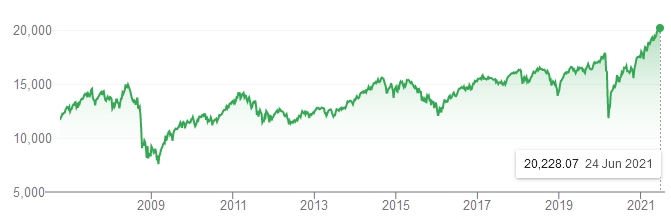
For many investors, the pains of the ‘08/’09 Financial Crisis and 2001 “Dot Com Bubble” still linger when looking at their statements. When you look at the history of the Canadian stock market, you can plainly see downturns scattered throughout. How can someone approaching retirement, or already in retirement, navigate these waters without ruining their finances for good?
Start With A Plan
Don’t go into retirement without a proper investment plan for how you’ll handle the next, inevitable bear market. Instead, be ready and know the steps you can take reduce or eliminate the strain it can put on your long-term financial prospects.
Think of the stock market as a yoyo. A yoyo being played as a person walks up the stairs. We know, given enough time, the stock market has always trended up. On any given day/week/month/year however, it can be on a downward trajectory. The key to a good investment plan is finding ways to give the yoyo time to move back up the string.
Evaluate Strategies
You can buy your portfolio time and reduce market risk for your retirement in a number of ways. Each has their own pros and cons, and every retiree has different appetites for each option. Consider:
- Working longer. Are you prepared to work an additional six months? A year? Two years? If the markets dip as you approach retirement, would you work through the downturn and wait out your assets’ recovery?
- Reducing spending. Drawing down less on assets in “bad” market years can soften the blow of market dips. If you have a good deal of control over discretionary spending, putting off that vacation can give your investments the time they need to bounce back.
- Adjusting your portfolio. Being strategic with your investment selection can insulate your income from market ebbs and flows. Consider keeping 1-3 years of retirement income in low-to-no risk holdings for drawdown in turbulent market cycles. This gives you the power to avoid selling your equity holdings at inopportune times! The downside is you can expect to earn less on these holdings in good years, given “less risk” tends to equate to “less reward.”
Implement It
Having a plan in place and knowing your options is critical. But if you never implement it, it’ll all be for naught! Commit to your action steps and you can sleep easy knowing you’re prepared to weather any storm.

Recent Comments