
by Thomas Johnson
The last few years have been tumultuous for North American stock markets. March 2020 was one of the sharpest drops in history and, since then, the major indices have rebounded and hit record highs. These rapid changes in equity and bond markets can cause problems for do-it-yourself investors or those whose advisors are slow to react. Chief among them: Portfolio Drift.
What Is Portfolio Drift?
It’s a phenomenon where the different holdings in a portfolio, growing at different rates, can unintentionally alter your asset allocation.
That’s a lot of jargon in one sentence. To illustrate better, let’s look at a simplified example:
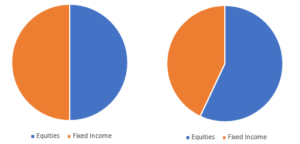
Assume Judy has $100,000 in her investment account and, as a balanced investor, she wants 50% to be in bond holdings and 50% to be in equity holdings. After a while, perhaps her bonds have grown in value from $50,000 to $52,000 but her equities have grown from $50,000 to $70,000. Now she’s no longer in a 50/50 split, but rather in a 43/57 allocation instead.
What’s The Harm?
Judy, simply due to market movements, has had her portfolio become much riskier due to portfolio drift. Should equity markets lose money in the future, she’ll be hit much harder with 57% of her holdings in equities than she would be at 50%.
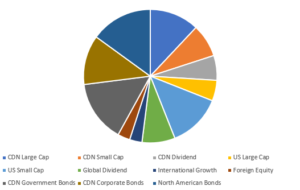
Correcting this drift, in the Judy example, is relatively easy. She rebalances by selling some of her equities and buying some more bonds. In real world scenarios it can be a little trickier when portfolios consist of several holdings (see example below). Rebalancing also requires you to factor in potential fees or taxation in the form of capital gains and losses.
What Should You Do?
Reviewing your investments on a routine basis for portfolio drift is a great habit to build. You’ll naturally be “selling high” on holdings that have performed above average and “buying low” on holdings that have lagged; all while keeping your portfolio in line with your desired level of risk. If you’re at or near retirement, regular rebalancing is even more critical in being defensive against market drops!
If you haven’t looked at your investment portfolio for strategic rebalancing in a while, now is the perfect time to do so. The dramatic market movements over the past few years has put many accounts out of line with their owner’s objectives and can often be solved with minimal effort. Moral of the story: don’t let portfolio drift disrupt your retirement plans!
by Thomas Johnson
If you’re a Manitoban who owns any of the following: a pension through work, a Locked-In Retirement Account (LIRA) or a Life Income Fund (LIF), then recent legislation is about to dramatically change your retirement vision. Bill 8, titled “the Pension Benefits Amendment Act” is one of the biggest changes to the pension landscape in years.
This bill effectively makes pension unlocking far, far easier than ever before for Manitoba pensions. Coming into effect on October 1st, it provides unlocking under two circumstances:
- It expands the rules of accessing pension funds in cases of financial hardship. If you’re struggling with low income, rental eviction, mortgage foreclosure or medical debts, you may be able to access some of your pension funds to help offset.
- It allows for Manitobans, 65 and older, to fully unlock their entire pension. LIFs traditionally have an annual cap on the amount you can withdraw in any given year. For qualifying plans, that restriction can be removed, entirely!
I’ve written previously about Manitoba’s ability to unlock 50% of your pension. Bill 8 completely upends that strategy by enabling 100% unlocking. This has many significant pros and also some potential cons.
Pros:
The benefits to unlocking your pension are relatively apparent. You can take more money from your pension in a given year than previously allowed. Do you want to travel more or upgrade your home in the early years of retirement? Go ahead! Do you want to strategically tax plan around low-income years? Now you can!
Flexibility in retirement income planning is incredibly valuable. Bill 8 gives Manitobans, with pensions, full control in planning for their futures.
Cons:
The biggest risk that Bill 8 introduces is the risk of outliving your money. When you could only unlock half of your pension, the remaining half is effectively shielded from your own desire to spend. By legislatively restricting withdrawals, the province protected individuals from rapidly depleting their retirement resources.
Takeaway:
If you can handle the personal responsibility of budgeting your retirement income, then unlocking your pension becomes a huge win. You now have maximum control over funding your lifestyle.
If the idea of budgeting and holding yourself accountable to not overspend is daunting, don’t do it! Following the legislated LIF maximum guide is a great way to avoid depleting your accounts too rapidly.
Starting October 1st, you should have a conversation with your Financial Advisor on what unlocking your pension could mean for your retirement. How can you take advantage of this change? How can you protect the longevity of your money? Bill 8 is a brand new tool in your financial toolkit that could make all the difference for your future!

by Thomas Johnson
Manitoba is home to many, many industries that feature pension programs. Education, Finance, Healthcare, Manitoba Hydro, the list goes on and on!
If you contribute to a defined benefit pension through work, you may have noticed an interesting trend: the commuted value of your pension has gone up dramatically year-over-year! What is causing this trend? Why, all-of-a-sudden, is the lump sum value of your pension so much higher?
Defined Benefit Pension Basics
Let’s start at ground level as we answer this question. A Defined Benefit Pension means your employer is guaranteeing a specific retirement income in the future. That income amount is typically a formula, using a combination of a) years of service, b) average salary and c) age at retirement.
Calculating the Commuted Value
To get the lump sum or commuted value of your pension, you need to start at the end and work backwards. The pension provider doesn’t hold a lump sum with your name on it. Instead, they need to figure out what dollar amount would provide you with that guaranteed income using the prevailing interest rate. They start with the income promise and then reverse-engineer the lump sum needed to make it happen.
It (Largely) Boils Down to Interest Rates
When interest rates are high, it takes less lump sum money to create an income. When interest rates are low, as they are today, it takes more cash up front to guarantee an income. Makes sense, right? If you can easily earn a higher interest rate on your principal, you need less principal invested to achieve the same outcome.
Looking closer, the math can be quite tricky on this one (which is why actuaries are paid well). For easy comparison, let’s look at a ‘perpetuity,’ which can be thought of as a never-ending pension. The formula for a perpetuity is simply Income / Interest Rate = Lump Sum.
For example, a $50,000/year perpetuity in a 5% interest rate environment requires $1,000,000 to sustain. The same $50,000/year perpetuity in a 2% interest rate environment requires $2,500,000 to recreate!
What to Do With This Information?
When you look at your pension statement and see a dramatic increase in the commuted value, be aware that it’s likely temporary. If/when interest rates rise again, you’ll see that valuation fall accordingly.
If your retirement plans are to take the pension income, this has no real effect on you. If your retirement plans are to commute the lump sum, now might be a great time to consider doing so!
No one has a crystal ball to pinpoint when interest changes are going to arise. This interest rate environment could go on for months or years. What you can do is be aware of how changes will impact your pension plan and adapt accordingly.

by Thomas Johnson
If you’re a regular reader of my blogs, you’ll likely see a common trend. I never recommend one particular outcome for everyone. I instead devote this space to weighing pros and cons and identifying pitfalls or opportunities.
The reason for seeming indecisive? Financial advice needs to be unique! Finance itself is all about optimizing money decisions. But that optimal outcome is wildly different for every person reading these sentences.
I’ve come across countless authors and media personalities who claim there is only one path to financial success. You know it when you see it. If anybody suggests, “all you need to do is follow my formula to riches,” that should be your cue to turn and run!
A common piece of retirement advice is to “invest 10% of your income in a fund mirroring the S&P 500 index.” If you follow that advice it can’t possibly mislead, right? Well, what if a person can’t afford 10% of their income towards retirement today? What if you want to retire sooner than 65 or never truly retire at all? What if you have a pension program through work that’s already saving 12% of your income per year? What if you can’t stomach the volatility of the S&P 500? Is that savings to be directed into RRSPs or TFSAs or Non-Registered accounts? The list of questions to refine that blanket statement into an actual, implementable decision is too high to count.
Some more dangerous pieces of advice, that seem to surface regularly, involves real estate or complicated tax shelters. Here is where I can give some decisive advice, regardless of situation:
- If you need to pay hundreds of dollars to attend a seminar to learn how to build wealth, the only person getting wealthy is the seminar host! After all, if they can make millions off their own ideas, why rent a hotel conference room to make thousands?
- If someone is selling you something on the basis that the tax decrease will be equal to (or greater) than the cost of the investment, you’re in trouble. There is no real, legal way to do that in Manitoba without placing all your principal at risk of loss. Most tax savings are based on credits or deductions, which cap out at around $0.50 for every $1 spent in our province.
Every person is different when it comes to their financial lives. We all are. There are so many variables at play it is impossible to find two people who are actually identical. You would be truly hard-pressed to find a financial “doppelganger” who shares the same: age, life expectancy, earning power, tax situation, family situation, goals, values, etc… So why listen to someone who is giving blanket, cookie-cutter advice?
Learning to ask the right questions, and critically evaluate financial alternatives, is a skill that takes time. I’m a firm believer that an informed person can make the right decision and find the optimal outcome for their personal situation.

by Thomas Johnson
According to the Canadian Life and Health Insurance Association, the average Canadian Household owns $432,000 of life insurance coverage. That’s a lot of money in play when determining what expenses to keep and which ones to cut in retirement. Do you keep paying premiums on a fixed budget? Do you sever ties and cancel the contract?
Here are a few pointers on how to make the correct decision for your family:
Avoid the “Sunk Cost” Fallacy
The idea behind the “sunk cost” fallacy is we, as humans, have a behavioural tendency to overvalue stuff that we’ve invested time or resources into already. “Past You” has paid premiums for years or even decades; that makes it easy to feel like you’re owed something in the future. But “Present You” has a choice on how to spend future dollars that should be independent from historical contributions. We can’t un-spend those dollars. The past is truly in the past.
That life insurance policy has likely done its job all along. It has given your family peace of mind and assurance that your passing wouldn’t be financially devastating. Your decision on what to do next shouldn’t have any ties to what has happened in the past.
Re-evaluate Your Insurance “Need”
How much insurance would your family need if you passed away today? What assets do you have that will fill the financial gap? How much tax or debt will need to be collected and where will that money come from? Are there certain financial gifts you wish to leave behind?
These questions are fundamental to making a decision on your insurance policy. If you’re already in a position to fund all of your estate goals and obligations, maybe you don’t need to own insurance anymore. Maybe you want to achieve a particular outcome that is only attainable by maintaining the insurance. In any case, you need to know how your estate will unfold to determine if a cash injection from an insurance policy will still be beneficial.
Ask “What Can My Policy Still Do?”
Many life insurance policies come with options. Options to increase or decrease coverage. Options to extend or prolong the life of the policy. Perhaps even options to increase your retirement income. Get all the data on the table in front of you to determine if your existing policies can meet your needs today.
At the end of the day, choosing to maintain OR end your relationship with life insurance is perfectly OK. If saving the premium payments each months gives you financial peace of mind, it is worth it! If continuing to own life insurance for the benefit of others helps you sleep at night, it is worth it!
The choice is uniquely yours to make, so long as it’s an informed decision and comes from a place of control. I’ve never met a family that didn’t support a parent’s decision to own or cancel insurance. Their love and support in your decision making should give you peace of mind regardless of the outcome!

Recent Comments